
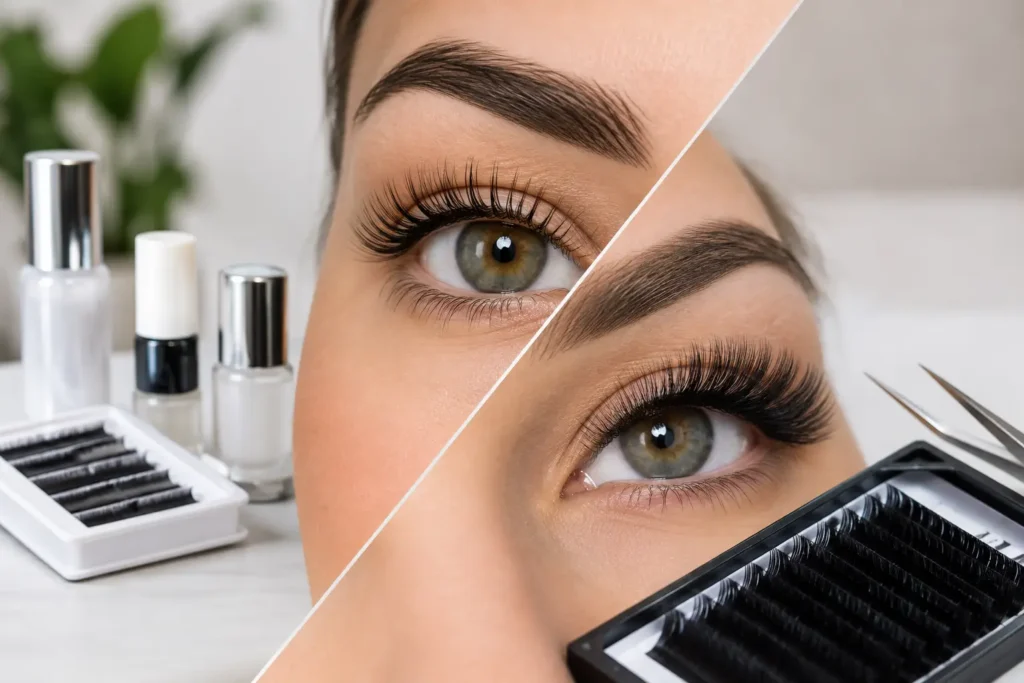


A client with straight but dense natural lashes doesn't necessarily need volume eyelash extensions. For her, a well-done lamination can give a cleaner, more open look and a result that fits her everyday life. On the other hand, with sparse, short, or downward-pointing lashes, lamination has a natural limit. That's exactly why the question of lamination vs. extensions shouldn't come down to which procedure is better. For a professional, the right question is: which service will give a safe, predictable, and sellable result for this particular client?
Lamination vs. extensions: the difference starts with the natural lashes
Lamination works with the client's own lashes. Through controlled steps of softening, shaping, and setting, the hair is lifted from the root and placed in a visually more expressive position. The procedure is often combined with tinting, which makes light tips more visible and defines the lash line without mascara.
Extensions, or eyelash extension procedures, add artificial lashes to the natural ones. This makes it possible to change not only the curl but also the length, density, volume, and overall design. The classic technique creates a more natural lengthening, while volume and hybrid sets give a fuller line and a stronger effect.
The difference is significant in the consultation too. With lamination, the specialist assesses the length, direction, elasticity, and condition of the natural lashes. With eyelash extensions, this also includes choosing the map, lengths, curls, thicknesses, adhesive, and the right weight for each natural lash. In both cases, technique can't make up for a wrong assessment.
What the final effect looks like
Lamination gives the impression of longer, lifted natural lashes. The result is subtle but visible, especially when the client has medium to long lashes that grow straight or downward. It's a good procedure for people who work out, travel often, don't want maintenance every few weeks, or simply prefer a look without added lashes.
Extensions give you control. The lash artist can build a cat eye, squirrel, doll effect, or a custom map based on the eye's anatomy. They can visually correct a slightly drooping outer corner, create a more defined lash line, or achieve soft everyday volume. But control doesn't mean every client wish is technically possible. Lashes that are too long or heavy on a weak natural base put retention and lash health at risk.
When the client wants to look as if they were born with more beautiful lashes, lamination is often the right recommendation. When they want a clearly visible makeup effect from the moment they wake up, eyelash extensions have more potential.
Longevity, maintenance, and time in the schedule
The lamination effect usually lasts about 6 to 8 weeks because it follows the natural lash cycle. The look changes gradually as new lashes grow in, without a sharp line of wear. The client doesn't come back for a fill but for a new procedure after a suitable interval, determined by the condition of the lashes and the system used.
With extensions, a beautiful result depends on regular fills. The usual interval is 2 to 4 weeks, but the actual frequency is affected by the natural lash cycle, home care, skin type, cosmetics around the eyes, and the chosen look. Dense mega volume, for example, may look uneven sooner than a light classic set.
This directly affects how the salon is organized. Lamination is a service with a shorter session and less frequent return visits. Eyelash extensions create regularity and predictable visits but require more time to build, precise isolation, and a constant stock of supplies. Neither model is automatically more profitable. Profitability comes from correctly calculated time, materials, pricing, and a full schedule.
Safety: a procedure is good only when it's suitable
For both services, safety starts with a client history and clear communication. Active eye inflammation, conjunctivitis, a stye, recent eye surgery, a strong allergic reaction, or a visibly damaged area are reasons to postpone the procedure and refer the client to a medical professional if needed.
With lamination, the main risk is choosing the wrong silicone pad, excessive processing time, or imprecise work with the products. Over-processed lashes can look dry, frizzy, or point in random directions. You shouldn't promise the same result for very short, strongly curled, or already damaged natural lashes.
With eyelash extensions, the critical factors are isolation, the amount of adhesive, the distance from the skin, the freshness of the adhesive and the conditions in the room. Stickies and overloading with fans that are too heavy are unacceptable. Good retention isn't achieved with more adhesive but with precise prep, suitable humidity and temperature, steady technique, and compatible products.
Eye patches, primer, remover, cleansing products, and hygiene supplies are also part of safety, not secondary accessories. Working with professional supplies of clear origin that are stored correctly reduces the risk of compromising the procedure.
How to guide the client to the right service
Instead of asking only what effect they want, start with their daily routine. Do they wear contact lenses? Do they tend to rub their eyes? Are they ready for regular fills? Do they like a made-up look or prefer a natural result? What do their lashes look like without mascara? These questions lead to a more accurate recommendation than a photo of someone else's set on social media.
Lamination is a logical choice for a client with good natural potential who wants low maintenance and a natural look. It's also a good service for clients who aren't ready for eyelash extensions but want a more polished look. Tinting can be a valuable add-on when the lashes are light and the curl effect alone isn't visible enough.
Extensions are more suitable when the natural lashes are sparse, the client wants length or volume, or has a specific design goal. They're also the better option for people who want a constant finished look without applying mascara every day. The condition is that the client accepts the need for maintenance and follows the aftercare recommendations.
Don't sell a procedure, sell the right solution
Sometimes the most professional answer is to decline the requested service on a given day. If the lashes are exhausted after a previous lamination, it's wiser to wait. If the client has very weak natural lashes, extreme volume isn't a good idea. A short-term no protects the specialist's reputation far more than a set that only looks impressive in a photo.
For salons that offer both procedures, a practical approach is to keep clearly separate work kits. For lamination, this includes a step-by-step system, silicone pads in different sizes, adhesive or setting balm, applicators, micro brushes, tint, and protective materials. For eyelash extensions, you need lashes in your go-to curls and thicknesses, an adhesive suited to the conditions, tweezers, eye patches, primer, remover, and hygiene supplies.
Regularly tracking expiry dates, batches, and stock saves you from interrupted appointments and last-minute substitutions. VM Beauty's professional catalog is structured around the real workflow, from the essential supplies for a beginner to regular restocking for an established salon.
The strongest recommendation isn't the one that brings the highest value per procedure, but the one after which the client comes back with beautiful, healthy lashes and the confidence that they got a solution tailored to them.



