
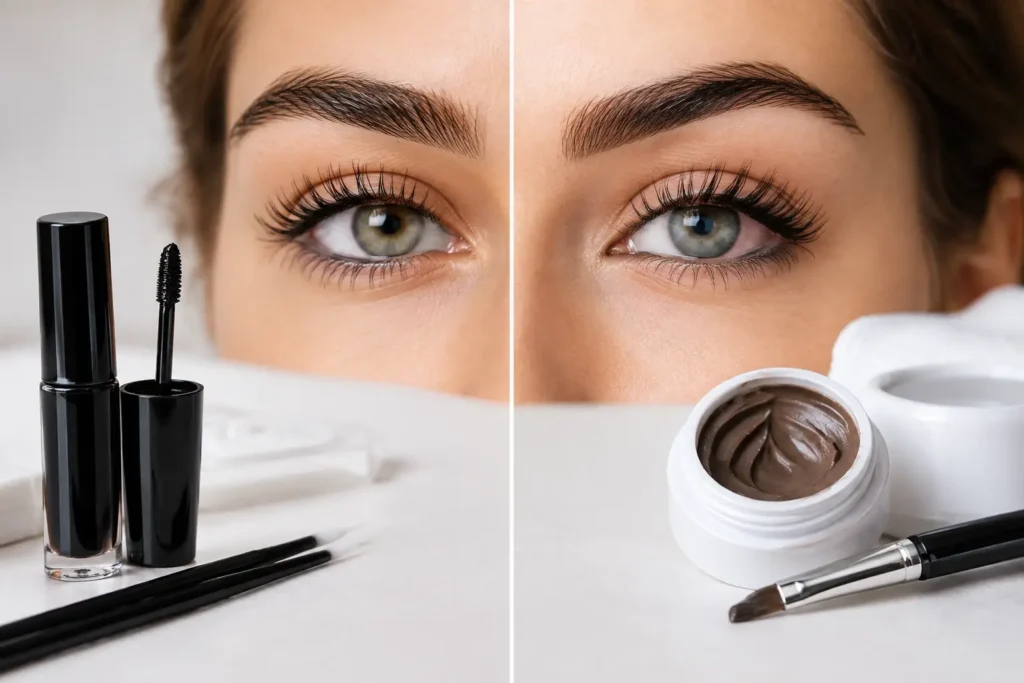


When a client asks for more defined but natural-looking brows, the choice between hybrid vs. cream tint isn't a matter of personal taste. It determines the intensity of the stain on the skin, how the tint behaves on the hair, the working time, and the expectations you need to set before the procedure. For a brow artist, the right formula is the one that suits the specific skin, hair, and desired finish, not simply the tint with the darkest shade.
Cream tint remains a familiar, reliable standard in many salons. Hybrid tint, on the other hand, is preferred for services with a more visible skin stain and an effect close to lightly defined makeup. Both have a place in a professional kit. The difference is in how you use them.
Hybrid vs. cream tint: the main difference
Cream tint is designed mainly to color the hair. With the right formula and developer it gives an even, predictable result and can lightly stain the skin, but that isn't its main strength. That's why it's a practical choice for clients with dense brows, where the goal is to emphasize the natural hair, neutralize an unwanted undertone, or cover lighter areas.
Hybrid tint colors both the hair and the skin more noticeably. With good prep of the area, it creates a clear visual frame for the brow and visually fills in sparser areas. This makes it especially suitable for clients who don't want to fill in their brows every day but aren't ready for permanent makeup.
The term “hybrid” doesn't mean all products work the same way. Formulas differ by brand, activator, processing time, and recommended mixing method. Always follow the technical instructions for the specific line instead of carrying over ratios from another tint.
When cream tint is the better choice
Cream tint wins when you're after softness and control rather than a strongly defined skin stain. It's a sensible option for a first tint, for very light and fine hairs, or for clients who worry about an overly graphic result. On a well-shaped brow with enough volume, tinting just the hair is often more than enough.
It also works well for correcting an undertone. For example, if the natural hair has an overly warm or reddish undertone, a professionally chosen cream tint can balance it without leaving a harsh stain on the skin. This is valuable for mature skin, dry skin with uneven texture, or clients who prefer a subtle effect.
Lamination pairs very well with cream tint, as long as the protocol for the system and the tint allows combining them. After lamination, the hair is usually more porous and absorbs pigment more intensely. So don't automatically use the same processing time you use on non-laminated brows. Assess the elasticity, porosity, and condition of the hair after the procedure.
When to choose hybrid tint
Hybrid tint is a powerful tool for brow artists who build a more defined shape. It works well for sparse brows, small gaps, and asymmetries that can be visually balanced with a carefully applied stain on the skin. With proper mapping and a clean outline, the result looks neat and finished right after the procedure.
This type of tint is also a logical choice for clients who like the effect of a pencil or brow powder but want to cut down their morning makeup time. Here the consultation is crucial. Explain that the skin stain isn't permanent and that how long it lasts depends on skin type, home care, cosmetics, and face washing.
On oily skin, the skin stain usually fades faster. On dry, well-prepped skin it can last more evenly, but flaking and dehydration can also shorten its life. Don't promise a fixed number of days. It's more professional to explain the range of expectations and the factors that affect them.
Hybrid tint requires more precise work along the outline. Applying it outside the shape, insufficient degreasing, or an uneven layer show up immediately. This isn't a flaw in the product but a sign that prep, mapping, and technique need to be at a high level.
Prep matters more for longevity than the shade
Whether you work with cream or hybrid tint, the result starts before mixing. The skin must be cleansed of makeup, SPF, sebum, and oil residue. The brows are brushed, the density and direction of the hair are assessed, and the shape is matched to the face and natural symmetry, not to a template line.
With hybrid tint, degreasing is especially important because you need even contact with the skin. If there's active sebum in the T-zone, the tint may take patchily or not leave enough of a stain. With dry skin, don't overdo aggressive cleansing, because irritated, flaking skin isn't a good base for a clean result.
Before any tinting, review previous procedures. Remnants of permanent makeup, microblading, a chemical peel, retinoids, active dermatological treatments, or a recent lamination can change your approach. If you suspect a contraindication, postpone the procedure. A quick service isn't worth more than the client's peace of mind and the salon's reputation.
The shade isn't chosen by hair color alone
Black isn't a universal solution for dark brows, just as light brown isn't the automatic choice for blonde clients. Look at the skin's undertones, the natural hair color, the root color, and what the client wants. A cool brown shade can look too gray on warm skin, while a shade that's too warm can give an unwanted orange or reddish cast.
When mixing shades, work with a clear goal. You add a darker tone for depth, a corrector for neutralization, or a lighter tone for softness. Record the ratios used in the client card. This saves time at the next visit and lets you track how the specific hair reacts to the formula.
A professional kit should include not only basic brown and black shades but also correctors, a suitable activator, non-metal mixing dishes, precise brushes, and materials to protect the skin. For lash tinting, use only products specifically intended for that area and follow the corresponding safety protocol.
How to explain the choice to the client
Instead of asking “Which tint do you prefer?”, steer the consultation toward the result. Do you want your brows to look fuller just in terms of hair, or would you like a light makeup effect on the skin as well? How often do you use a brow pencil? Do you have oily skin? Have you had a lamination recently?
These questions give you a real basis for choosing. A client with dense but very light brows may be ideal for cream tint. A client with sparse brows who shapes them every day will probably appreciate hybrid tint more. In some cases, the best solution is a softer shade and a shorter processing time, not switching to a darker formula.
Do a sensitivity test according to the manufacturer's instructions, and don't skip it with a new product or a new client. It's part of the professional standard, not an extra step. The same goes for home care instructions: avoiding hard rubbing, oils in the area, and aggressive cleansers for the first few days can help achieve a better visual result.
A working approach for more predictable results
If you're just adding hybrid tints to your menu, don't replace cream tints entirely. Test the formula on suitable cases and document the prep, processing time, and skin reaction. Before and after photos taken in the same lighting will help you evaluate the result objectively rather than by a momentary impression.
Keep the shades and activators you use most often in stock. Not having the exact product on the day of a booked client leads to compromises in color and technique. For salons and independent brow artists, reliable access to professional supplies is part of service quality, not just an administrative expense.
The right tint doesn't make all brows look the same. It lets you approach each case differently, with more softness when the natural hair is enough and more definition when the shape needs visual support. That's the difference the client sees in the mirror and comes back for.



