
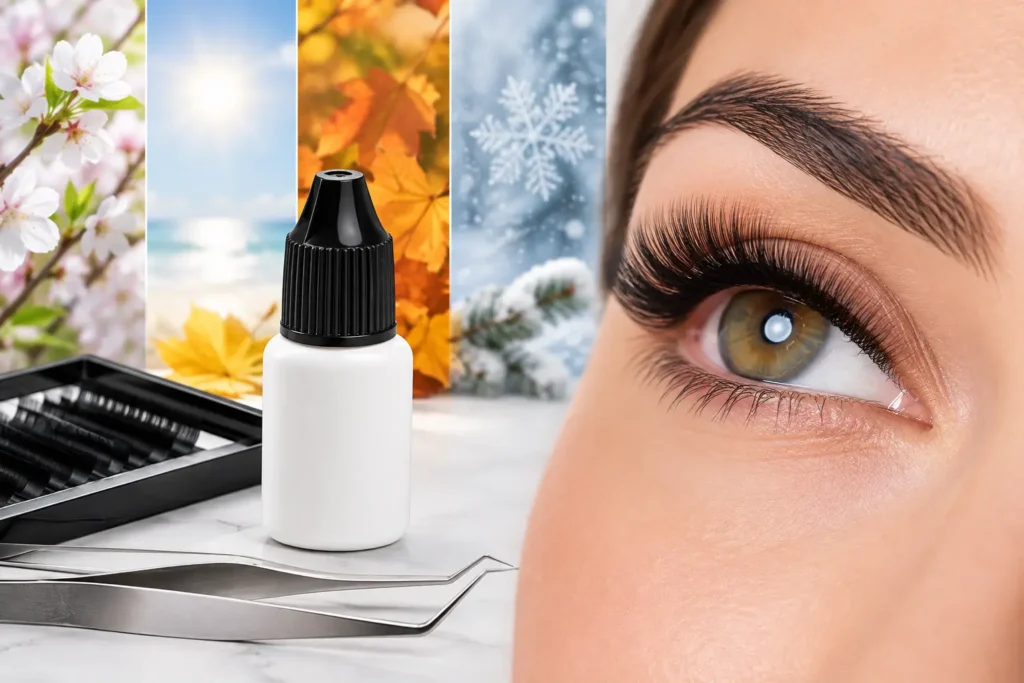


When the fan runs nonstop in July and the heating dries out the air in January, the same lash adhesive can behave like a completely different product. Changing adhesive by season isn't an unnecessary expense or a matter of habit. It's a practical way to control working speed, the amount of fumes and the retention of extensions.
In eyelash extensions, the adhesive doesn't work in isolation. Temperature, relative humidity, ventilation and even the number of clients in the room all affect how it behaves. A professional shouldn't wait for a wave of complaints about fallen lashes before adjusting their choice. The better approach is to monitor the environment and keep an adhesive that matches the real conditions in the work area.
Why the season changes how lash adhesive works
Most eyelash extension adhesives are cyanoacrylate-based. Cyanoacrylate polymerizes in response to moisture in the air. This means a change in humidity can speed up or slow down bonding, while temperature further changes how the adhesive feels to work with.
In the warmer months, the air in many salons is more humid and the temperature is higher. The adhesive may set faster than expected. If the artist works with a very fast-drying product, the base of the extension may start to polymerize before it's placed correctly. The result is weak adhesion, unstable direction or shock polymerization.
In the colder months, the picture often reverses. Heating lowers relative humidity, especially in small rooms. The drop then stays workable longer, and bonding to the natural lash may slow down. If the technique stays the same, the artist may place the extension too early or use more adhesive to compensate. Both approaches can hurt retention.
The season alone isn't a reliable criterion. An air-conditioned salon in August can be drier than an unheated room in March. That's why measuring is more reliable than guessing.
Changing lash adhesive by season: how to decide
Place a thermo-hygrometer near your workstation, but not right next to an air conditioner, radiator, open window or humidifier. Check the readings before the first client and whenever there's a significant change during the day. Then compare them with the range specified by the manufacturer of your specific adhesive.
Don't choose based only on the fast or slow label. Drying speed is a useful characteristic, but it also has to match your technique. An experienced lash artist who forms fans quickly can work confidently with a faster product when conditions allow. During training, on a classic set or at a slower working pace, a moderate speed often gives more control.
The most practical strategy is to keep at least two options in your professional stock: an adhesive for higher humidity and a warmer room, and one that stays predictable in drier air. This doesn't mean opening lots of bottles at once. It means being able to switch your working product in time, instead of losing hours trying to compensate for unsuitable conditions.
Signs it's time to change your adhesive
Not every difficulty calls for a new adhesive. First rule out mistakes in prepping the natural lashes, the amount of product, dipping technique and the condition of the drop. But if these factors are under control, the following signs deserve attention:
- the drop forms strings, thickens or changes consistency much faster than usual;
- extensions slide after placement, even though the natural lashes are well cleansed and degreased;
- the base of the extension seems to grab instantly, before you have time to position it precisely;
- retention gets worse when you have more clients in the same period, with no change in the lashes or prep you use;
- conditions in the room stay outside the range recommended for the opened adhesive.
It's important to tell a seasonal change apart from an expired adhesive. If the adhesive was opened long ago, stored incorrectly, or the bottle isn't cleaned after use, the problem may be the product itself, not the climate. Keep a short log with the opening date, brand, and the temperature and humidity you observed. With regular work, this information quickly reveals the patterns in your salon.
Working in summer: don't make up for speed with more adhesive
In hot, humid weather, the main temptation is to take a bigger drop or dip deeper because the adhesive seems unstable by the end of the day. This usually doesn't solve the problem. A larger amount increases the risk of stickies, a heavy base and more fumes.
The better solution is to refresh the drop more often, monitor the actual humidity and, if needed, switch to an adhesive with a speed better suited to high humidity. Avoid a direct stream of air from the air conditioner onto your palette. It creates local, constantly changing conditions and makes your work unpredictable.
In summer, clients often use more sunscreen, serums and oil-based products. This also affects adhesion, but it shouldn't automatically be blamed on the adhesive. Consistent prep with a suitable cleanser or primer, as the procedure requires, is still a must.
Working in winter: manage dry air sensibly
When humidity drops, some artists start working too slowly for the adhesive or hold the extension on the natural lash for longer. This slows the pace and doesn't guarantee a better bond. If conditions are consistently dry, it's better to use an adhesive designed for that range or to carefully stabilize the environment.
A humidifier can help, but only if you use it with measurements. Don't direct steam at the work area and don't make the room overly humid within minutes. A sudden change is a problem too. The goal is consistency, not chasing a single value at any cost.
Check the temperature of your supplies too. If the adhesive was delivered in cold weather, let the unopened package reach room temperature before using it. Condensation and sudden temperature changes can compromise the product.
Storage matters more than it seems
Even the best seasonal adhesive won't deliver if it's stored incorrectly. Keep unopened products according to the manufacturer's instructions, away from sunlight, heat and moisture. After opening, clean the nozzle, close the cap tightly and don't leave the bottle on the lash bed between clients.
Don't mix drops from different adhesives and don't add thinners. Each formula has its own chemistry and its own working range. When you switch brands or lines, run a control test in conditions close to your usual work before using it on a busy day.
For salons with more than one lash artist, it makes sense to have a shared standard: where the climate is measured, when the drop is replaced, how the opening date is marked and how backup products are stored. This reduces differences in results between artists and makes it easier to plan orders.
VM Beauty keeps a professional selection of lash adhesives and eyelash extension supplies, so your salon is never left without a working option when the weather or room conditions suddenly change.
Changing adhesive by season isn't a sign that your technique falls short. Quite the opposite – it shows you run the procedure as a professional process. Monitor your environment, know how your product behaves, and let the adhesive work for you, not against your schedule.
Вижте още: eyelash extension adhesive.



