


Your first lash studio start is not solved with a big order of random products. It is solved with a working system: supplies you know, a hygiene process, enough reserve of key supplies and a clear idea of how much time each procedure costs. A beautiful interior attracts attention, but consistent eyelash extension results build repeat visits.
For a beginner lash artist, the most sensible approach is to start with a limited but functional range. That way you will learn what your clients are looking for, which curls you work with fastest and which adhesive is predictable in the real conditions of your room. At first, you do not need to stock every thickness, length and ready-made effect on the market. You need to deliver the most common requests confidently.
A lash studio start begins with a service, not a cart
Before choosing lashes and tools, decide which services you will open your schedule with. Classic one-to-one, light volume and a hybrid effect are a good foundation because they cover a wide range of wishes. If you are still mastering the technique, do not add mega volume just because it seems popular on social media. It requires fast and clean fan making, control over the amount of adhesive and good judgment about the load on the natural lash.
Choose styles you can repeat confidently. A classic set suits clients looking for natural definition. Hybrid eyelash extensions combine classic lashes and volume fans, while 2D-4D volume gives a more pronounced line with the right thickness. Each service should have a realistic procedure time, material cost and a price that covers your work, not just the box of lashes.
At the start, it helps to create a procedure protocol: consultation, natural lash analysis, cleansing, isolation, application, check for stickies, finish and aftercare instructions. This reduces mistakes, especially once you start taking more appointments.
Basic supplies for your workstation
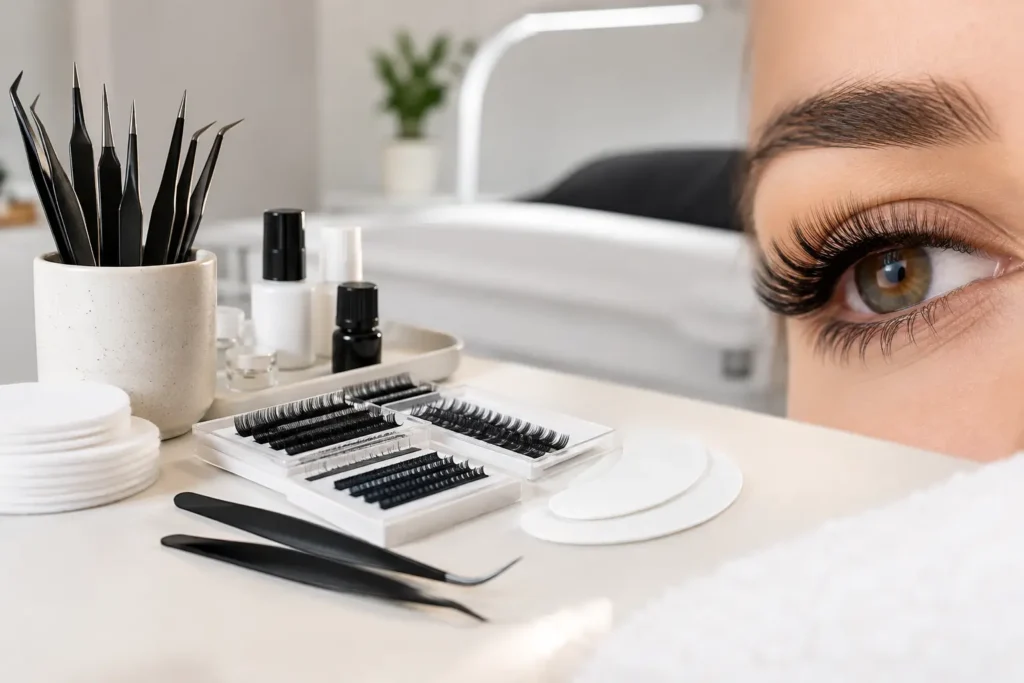
Your work table should not be cluttered, but it also should not make you interrupt the procedure to search for a supply. Plan your purchases in four groups:
- application supplies: extension lashes, lash adhesive, a palette or jade stone, adhesive stickers and micro brushes;
- prep and removal products: a cleanser, primer if needed, remover and lint-free applicators;
- isolation and comfort: eye patches, medical tape, lash brushes, a fan or blower and products to reduce fumes depending on your technique;
- tools and hygiene: two reliable tweezers, scissors, disinfectant, closed containers, disposable supplies and lighting.
For classic eyelash extensions, work with one stable straight or slightly curved pair of tweezers for isolation and one curved pair for application. Do not buy many models before you have found out which grip is comfortable for your hand. Good tweezers should close precisely along the entire contact zone without requiring extra pressure. For volume technique, you can add tweezers suitable for fan making, but that is a next step, not a mandatory expense on day one.
Your lash range also needs logic. For a start, trays with the most popular lengths, for example from 7 to 13 mm, and the basic C and D curls are practical. The C curl is more versatile and natural, while D is more visible and often chosen by clients who want a more open look. Do not use length as the only criterion. The eye shape, growth direction, condition of the natural lashes and desired effect determine the mapping.
When it comes to thickness, there is a clear working principle. For classic application, 0.10, 0.12 or 0.15 mm are often used, but the choice depends on the strength of the natural lash. For volume fans finer options such as 0.05, 0.06 or 0.07 mm are suitable. Thicker material does not mean a better result. If the load is excessive, retention and the client's comfort suffer.
Lash adhesive is the product that requires the most control
Lash adhesive is not chosen by drying time alone. The temperature and humidity in the studio directly affect how it behaves. A fast adhesive may be excellent for an experienced lash artist in a controlled environment but cause problems for a beginner who is still building speed and placement skills.
Check the manufacturer's recommended conditions and monitor the actual conditions with a thermometer and hygrometer. If the drop becomes stringy, thickens too quickly or the bond is unstable, the cause may not be your technique. Humidity, temperature, the amount of adhesive, natural lash prep and the freshness of the product all work together.
Change the drop regularly during the procedure and store unopened adhesives according to their instructions. Do not buy a large stock just because of a lower unit price. Lash adhesive has a limited working life after opening, so turnover matters more than quantity.
Hygiene is part of the service and the cost
A clean workstation is not an add-on to a professional service. It is a condition for working safely and in an organized way. Set up separate zones for clean tools, used tools and disposable supplies. Disinfecting surfaces between clients, properly cleaning and disinfecting tools and disposing of supplies after use should be described in your daily process.
Eye patches and tape should be placed so that they isolate the lower lashes without pressing on the eye. Never compensate for an awkward position by pulling the eyelid harder. In case of burning, watering, swelling or a suspected reaction, stop the procedure and follow a professional safety protocol. Do not promise that the products are suitable for every case – a client history, contraindications and informed consent protect both the client and your business.
Lighting is also a working tool. Look for even light that does not cast heavy shadows or tire your eyes. A comfortable chair for the client and the right bed height are an investment in application quality. Back, shoulder and wrist pain is not a normal price for a growing schedule.
How to make a realistic starting budget
The most common mistake is looking only at the price of the starter kit. It is more useful to split the budget into one-time investments and ongoing costs. A bed, lamp, chair, tweezers, organizers and measuring devices are equipment. Lashes, adhesives, eye patches, micro brushes, tape, brushes and disinfectants are an ongoing cost that repeats with every procedure.
When setting a price, do not count only the lashes used. Include eye patches, lash adhesive, prep products, disposable applicators, cleaning time, rent, social security, payment fees and communication time. If you work from a home studio, the costs may be different, but your work does not become free.
Track what actually sells. If the C curl tray runs out twice as fast as D, that is a signal for your next order. If a certain remover is not convenient for your technique, its low price does not make it economical. A small stock with fast turnover is healthier for a new studio than a cabinet full of products with an unclear purpose.
VM Beauty is a partner option for professionals who want to organize their supply of materials for eyelash extensions, lamination, tinting and other specialized procedures without mixing random products into their working catalog.
Retention is built before and after the appointment
Good retention starts with the right choice of length and thickness, but continues with proper natural lash prep. Makeup, sebum and cosmetic residue interfere with the bond. That is why the initial conversation with the client is practical: does she use oily creams around the eyes, does she usually sleep face down, does she wear contact lenses, how does she remove her makeup and what result does she expect.
After the procedure, give short, clear instructions. The client should know not to get the area too wet right after application, depending on the characteristics of the adhesive used, to avoid oil-based products around the eyes and not to pull on the lashes. Recommend regular cleansing with a compatible product and timely fills. It is unrealistic to promise the same retention to every client – the natural lash cycle, home care and individual characteristics all matter.
Photograph your work in the same light and from a similar angle. This will help you see your own progress, analyze symmetry and build a portfolio without misleading editing. A good photo sells a service, but a clean line, no stickies and comfortable wear keep it in your schedule.
The first months are not the time to prove that you offer everything. They are the time to build a reliable standard, measure your costs and order with purpose. When every procedure has a predictable result and every material has a clear role on your work table, the studio starts to grow with control, not by luck.



