
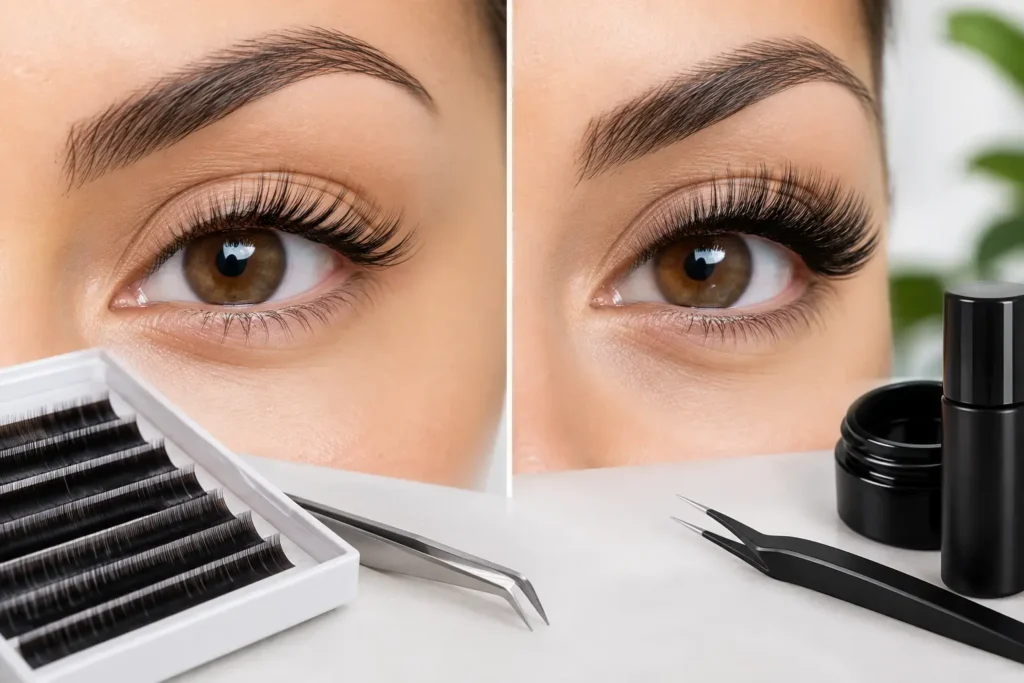


Classic vs volume lashes is not a question with one right answer. For a lash artist, it is a technical choice that determines the load on the natural lashes, the time in the schedule, the price of the procedure and, above all, whether the final result will meet the client's expectations. A good consultation does not start with the question “How much volume do you want?” but with an analysis of the natural base and daily habits.
Classic technique and volume eyelash extensions follow different logic. One puts precise isolation and the single extension first. The other builds density through fine, symmetrically opened fans. Both can look delicate or bold when done with the right lengths, curls and thicknesses.
What classic eyelash extensions mean
In the classic technique, one extension is placed on one natural lash – a 1:1 ratio. This is the foundation for developing adhesive control, proper isolation, direction and clean placement without stickies.
Classic lashes are a practical choice for a client with good natural density who wants a neat, lengthened and defined look. With the right thickness, the result can look very natural without the feeling of heavy makeup. The technique also works great for a first set, when the client is not yet used to how extensions feel.
The advantage for the specialist is the clear structure. Each natural lash gets its own extension, which allows good visibility of the lash line and precise correction of directions. However, this does not mean the classic procedure is automatically faster. With very dense natural lashes, a full set requires serious isolation and consistency down to the last lash.
When classic is the best fit
Classic eyelash extensions are a strong option for healthy natural lashes with medium to good density. They suit a client who wears glasses, prefers a light feel and wants a result close to their natural features. It is also often the sensible choice for a professional setting where the client wants a visibly defined but not dramatic look.
With sparse natural lashes, classic cannot create density where there is not enough base. Trying to compensate with too much thickness or length is a compromise that can worsen comfort, retention and appearance. In that case, the volume technique usually offers a better way to fill in visually.
How volume lashes work
In volume eyelash extensions, a hand-made fan of several ultra-fine extensions is placed on one natural lash. Depending on the number of fibers, we talk about 2D, 3D, 4D, 5D and higher volumes. The deciding factor is not just the number in the fan but its total weight, the width of the fan and the stability of the base.
Volume makes it possible to achieve a soft, fluffy and dense effect even with sparser natural lashes. With the right fine thicknesses such as 0.05 mm or 0.07 mm, the client can get an expressive look without unnecessary load. For a lighter textured effect, many specialists work with narrow fans and a moderate number of fibers instead of aiming for maximum density at any cost.
The technique requires more control. The fan must be evenly opened, with a thin and clean base, to have enough contact area with the natural lash. An overly wide fan can look scattered, and a heavy base increases the risk of twisting, stickies and weaker retention.
When volume is the right choice
Volume lashes suit a client with sparser lashes, visible gaps or a wish for a more pronounced makeup effect. They also allow more precise shaping of the eye – for example, a lift at the outer corner, softening a hooded lid or creating a more open look through strategic placement of lengths.
Volume is not necessarily dramatic. A light 2D or 3D set with fine fibers can be airier than a classic set with an overly thick single extension. Conversely, mega volume is not suitable for every natural base or every lifestyle. A client who wants minimal maintenance and a discreet result may be happier with classic or light volume.
Classic vs volume lashes: how to make a professional choice
The most useful approach is to see the technique as a solution to a specific task, not as a fixed category in your price list. Before application, assess the density, diameter, elasticity and direction of the natural lashes. Take into account the eye shape, the condition of the eyelid, whether the client wears glasses and the level of makeup they feel comfortable with.
Then clarify what “natural” means for that particular person. For one client, it is a slight lengthening with classic. For another, natural means a soft 3D effect that hides gaps but does not look like evening makeup. Inspiration photos are useful, but they need to be adapted to the actual natural base, not copied mechanically.
Choosing the curl matters as much as choosing the technique. C and CC often give a versatile, soft result, while D and more dramatic curls can open up the look but require enough contact area. Length should not follow only the client's wishes either. A smooth transition, stable wear and good direction are worth more than a few extra millimeters.
Time, pricing and work organization
Classic sets usually require less material per procedure, but not always less time. With volume lashes, tray usage and the work of shaping fans are greater, which must be reflected in the price. Underestimating this cost quickly turns an otherwise popular service into low-margin work.
For a stable workflow, keep separate, clearly organized trays for classic and volume. Check the shape of the strip, the evenness of the fibers, how easily they come off the strip and how the material behaves when fanning by hand. Fine volume requires tweezers with a reliable grip, while the classic technique needs comfortable isolation tweezers and constant visibility of the lash line.
The lash adhesive should be chosen according to your actual working speed and the temperature and humidity in the room, not according to the drying time promised on the label. If the specialist works more slowly than the polymerization, the base of the extension may remain weakly bonded. If the adhesive is too slow for their pace, the risk of stickies increases. This applies equally to classic and volume.
The most common mistakes when choosing a technique
The first mistake is choosing volume just because it looks more expensive or more striking. With very healthy and dense natural lashes, well-done classic can give a cleaner, premium result. The second is assuming that a thinner lash automatically allows an unlimited number of fibers in the fan. The total weight and the condition of the natural lash remain decisive.
The third mistake is using the same mapping for everyone. Cat eye, squirrel and doll effects must be adapted to the eye shape, the brow position and the natural directions. The fourth is skipping the conversation about maintenance. The client should know that retention depends on the natural lash cycle, home care, cosmetics around the eyes and regular cleansing, not just on the type of set.
For a professional, the strongest result comes from combining technique, quality material and an honest consultation. VM Beauty selects eyelash extension supplies so you can build a working kit based on your own pace, preferred thicknesses and the services you actually offer in your salon.
When your next client asks for “fuller but natural” lashes, do not rush to choose between classic and volume out of habit. Analyze the base, explain the options and offer a technique that will look good not only on the day of application but also in the weeks that follow.



