
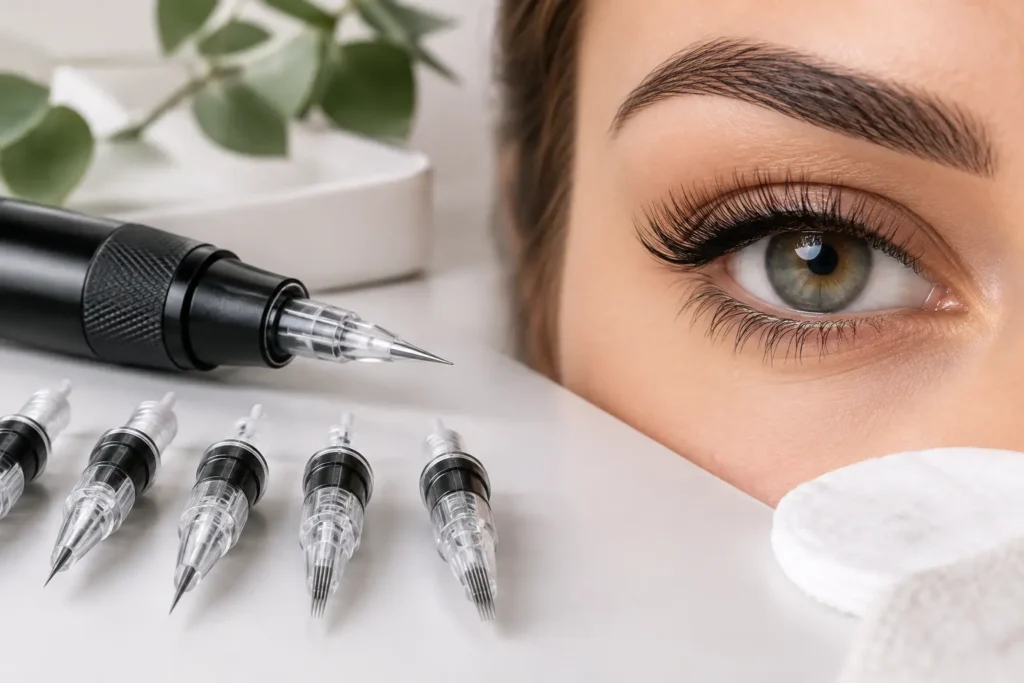


The same pigment formula can give a clean, even result or an uneven line with excess trauma – the difference often lies in choosing the right needle. When a specialist looks for types of tattoo needles, choosing just a brand or a price is not enough. The diameter, the number of needles in the configuration, their arrangement and the taper determine how the pigment enters the skin, how easily saturation builds up and how controlled the procedure is.
In permanent makeup, the needle is a working consumable that must match the technique, the area and the individual characteristics of the skin. There is no universal configuration for brows, lips and eyeliner. A practical choice starts with a clear understanding of what the markings on the packaging mean and how each needle behaves in real work.
How to read tattoo needle types
Most professional needles and cartridges are labeled with a combination of numbers and letters. The number usually shows how many microneedles are in the bundle, and the letters describe their arrangement. For example, 1RL is a single round liner needle, while 5RS means five needles in a round configuration for softer filling.
The diameter is listed separately or appears in the product specifications. In permanent makeup, fine diameters are common, as they allow precise work and more delicate pigment implantation. A thinner needle is not automatically the better choice: it requires a steady hand, correct machine settings and good technique. With the wrong speed or pressure, it may work inefficiently and prolong the procedure.
Another key parameter is the taper – the length of the sharpened point. A short taper works more densely and may suit faster color implantation. A long taper gives more precision and is preferred for fine details, but it does not forgive inaccuracies in angle and depth. Here the choice depends on the technique, not on which option sounds more high-end.
Main configurations and their uses
Round Liner – RL for outlines and detail
Round Liner is a configuration in which the needles are grouped tightly in a circle. It is designed for crisp lines, small details and controlled work in a limited area. The single 1RL is often used for hair stroke technique, fine accents and delicate outlines, when the specialist's method and training allow it.
Configurations such as 3RL or 5RL give slightly more density and can be a practical choice for eyeliner or lip outlines. As the number of needles increases, the line becomes wider. This can save time, but it reduces the freedom for micro-detail. For beginner professionals, it makes sense to first master control with the most commonly used configurations instead of ordering too many sizes without a specific task for each.
Round Shader – RS for soft filling
In a Round Shader, the needles are also arranged in a circle, but more loosely. As a result, the configuration does not leave as sharp an imprint as RL and allows softer pigment placement. RS needles are suitable for small fill areas, pixel work, ombré effect and softening transitions.
In permanent makeup, this configuration is often used for powder brows and detailed lip work. The choice between 3RS, 5RS or a larger size should follow the area and the desired density. A configuration that is too large for a small area can make gradients hard to control.
Magnum – M1 and M2 for larger areas
Magnum needles are arranged in two rows and cover a larger working area. They are used mainly for shading and filling. M1 is a classic magnum configuration with needles arranged in a staggered pattern, while M2 has a denser, even arrangement.
In permanent makeup procedures, magnum configurations are chosen carefully. They can speed up work on wider areas of the lips, but they are less suitable for fine outlines, small lips or precise details. They should not be seen as a way to get faster results at any cost. Speed only has value when control, evenness and client comfort are maintained.
Curved Magnum – CM for smoother transitions
Curved Magnum, also known as soft edge magnum, has a curved needle line. The outer needles are shorter and the central ones are longer. This shape distributes contact with the skin more softly and reduces the risk of visible edges when shading.
CM is a practical option for smooth layering of pigment and delicate transitions. On lips, it can help achieve even color over a larger area, but the size must suit the anatomy and the movement of the hand. The configuration does not replace proper pass technique and skin stretching.
Needles for brows, lips and eyeliner
For brows, the choice follows the specific method. For fine lines and hair stroke technique, specialists often work with single or small round liner configurations. For powder brows and ombré effect, RS or compact magnum options may be more suitable for building soft layers. The skin, previous permanent makeup, oiliness and the desired intensity all change the choice.
Lips require both precision for the outline and efficiency for the filling. A small RL configuration gives control in the delicate parts, while RS or curved magnum can support even color implantation in the inner area. Using one needle for the whole process is only possible if it matches the planned technique, not because it happened to be left in the work cabinet.
Eyeliner requires maximum discipline in choosing the configuration. The area is small, sensitive and does not allow a wide imprint. Fine liner needles are most often preferred, chosen according to the thickness of the line and the style of the procedure. A larger size does not automatically make the line more saturated – it may simply take away the chance for correction and a clean finish.
Cartridge or classic needle
Cartridge systems are preferred by many PMU specialists for the quick change of configurations and the convenient organization of the workstation. A quality cartridge should have a reliable membrane, a stable needle without side play and a body that gives good visibility of the pigment. The membrane is an important part of hygiene control, but it does not replace the rules for barrier protection, disinfection and single use.
Classic needles may be preferred with certain machines or an established personal workflow. What matters is checking compatibility with the device before ordering. An unsuitable grip, an unstable connection or a needle of unclear origin can compromise even the best technique.
How to build a practical working set
Instead of keeping a large number of random sizes, build your set around the procedures you perform most often. For each service, define a main configuration, an option for detail and an option for softer or faster filling. This keeps your stock clear and your orders predictable.
Track how each needle behaves with your machine, your specific pigments and your usual working speed. It is useful to record the configuration, the settings and the healed result on the client card. This turns the choice from guesswork into a working system and makes restocking supplies easier.
When buying, check the sterile individual packaging, the expiration date, the batch number, the membrane type for cartridges and compatibility with your machine. For salons and academies a steady supply of preferred formats is just as important as the unit price. VM Beauty maintains a professional catalog that makes it easier to plan regular deliveries according to your actual practice.
The right needle is not the one with the most promises, but the one that gives you predictable control in a specific procedure. When you know the configurations and keep a consistent working set, every next procedure starts in a more organized way – with less improvisation and more confidence in the result.



