
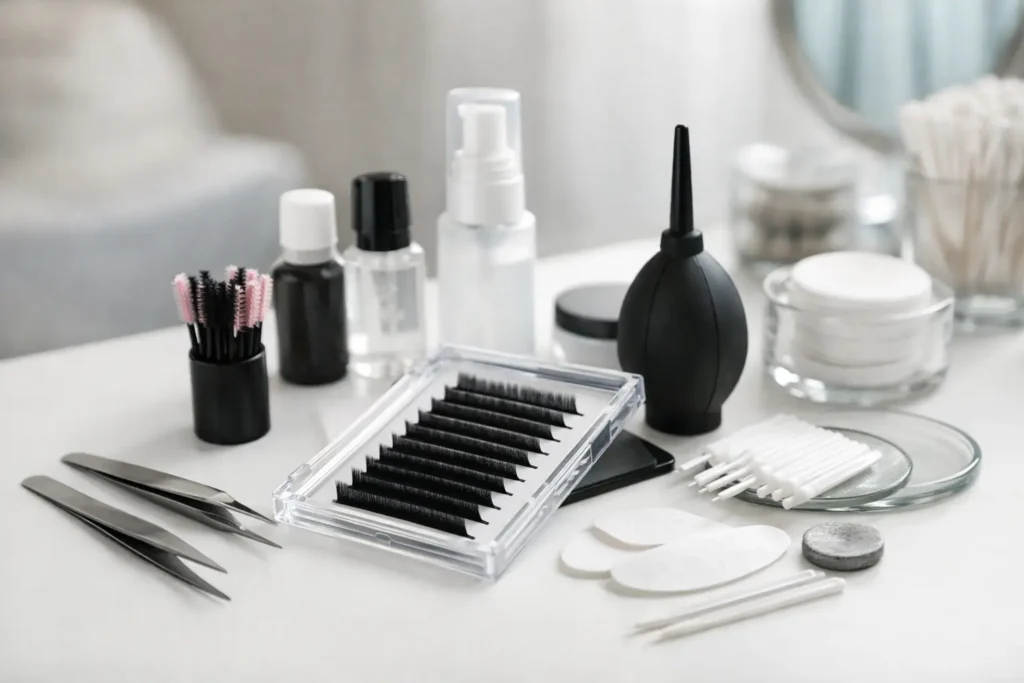


The first few eyelash extension procedures show whether the materials work for the specialist or the specialist works against them. A well-chosen eyelash extension starter kit isn't just a bundle of products at a lower price. It should provide control over placement, a clean workflow, and the ability to get predictable results with the classic technique before adding more complex volumes and effects.
The most common mistake for a beginner lash artist is buying a lot of everything: dozens of curls, thicknesses, tweezers and adhesives. This scatters the budget and overloads the work table with products that stay unopened. A smarter approach is a basic set of professional supplies chosen according to your training, the conditions in your studio, and the technique you'll actually be working with.
What an eyelash extension starter kit should contain
The foundation is clear: lash extensions, adhesive, natural lash prep, isolation products, precise tools, and hygiene supplies. Each category has a specific role. If one is missing or compromised, you'll feel it in your working speed as well as in the comfort and retention of the extensions.
Lash extensions for your first procedures
For classic eyelash extensions, lashes with a thickness of 0.15 mm and 0.12 mm are a practical start. They let you master isolation, picking up a single lash, and positioning without overloading the natural lash. A thickness of 0.10 mm is also a good option when the client has finer natural lashes or a softer result is wanted.
C and CC curls cover a large part of the demand in salon practice. C gives a natural, visible lift, while CC is suitable for a more pronounced effect. You don't need to stock every curl at the start. It's more important for the trays to have a reliable strip, even fibers, and stable color, so you don't waste time separating and placing lashes.
Lengths from 7 to 13 mm are a sufficient base for most classic sets. Mixed trays are an economical choice for practice and first clients because they allow smooth mapping. Once you start to recognize the most requested lengths in your practice, you can switch to single-length trays for better stock control.
Adhesive, primer, and prep products
Adhesive is the product that shouldn't be chosen only by its promised drying time. An adhesive with very fast curing can make things difficult for a beginner whose hand and isolation aren't yet confident enough. A more moderate speed gives time for correct positioning and reduces the risk of an unstable bond.
The temperature and humidity in the work room directly affect how the adhesive behaves. Before working, check the parameters specified by the manufacturer and monitor the conditions with a thermometer and hygrometer. If the room is too dry or too humid, even a quality adhesive may not perform as expected.
Primer prepares the natural lashes by removing sebum and cosmetic residue. It doesn't replace good cleansing. The kit also needs a lash cleanser, because a clean base is the first step toward good adhesion. Remover is also an essential professional product, used for safe removal of extensions, not for corrections during application itself.
Tweezers and work accessories
For the classic technique, you need two tweezers: a straight or slightly curved one for isolation and a curved one for picking up and placing the artificial lash. The best tweezers aren't necessarily the most expensive, but the ones with precise closing, a comfortable grip, and a weight that doesn't strain your hand during a long procedure.
Add a palette or holder for lash strips, a jade stone or another stable holder for the adhesive drop, adhesive rings if you prefer working that way, and spoolies. A mini fan can help with comfort at the end of the procedure, but it isn't a way to force curing instead of having the right working environment.
Isolation and hygiene in the kit
Under-eye patches should hold well without irritating the skin or slipping during the procedure. Choose a shape that suits the most common eye areas, and test the positioning before you start working. For extra hold or more difficult cases, you may need hypoallergenic tape.
Hygiene supplies are often overlooked in the first order, yet they're used up constantly. In your starter set, include micro brushes, lint-free applicators, lash spoolies, disposable pads, masks, gloves, and a disinfectant for the work surface. Tools should be cleaned and disinfected according to their purpose and the manufacturer's instructions.
Don't use the same applicator for several products, and don't return material to the original packaging after contact with the client. It's a small detail in the process, but it's part of the professional standard and protects the quality of your other supplies.
How to choose a kit based on your stage
If you've just completed basic training and are still building speed, focus on the classic technique. Don't buy volume lashes just because they seem more in demand. Volume requires a different thickness, working with fans, suitable tweezers, and a steady technique. Adding too many services too soon can lead to uneven sets and more wasted material.
If you're already taking models or clients, the kit should also be built with a reserve in mind. Adhesive has a limited shelf life after opening, but you shouldn't be left without a working bottle on the day of a booked procedure. The same goes for eye patches, micro brushes, and your most-used lengths. A small reserve of key supplies is more useful than a large number of rarely used trays.
For academies and instructors, the logic is different. They need formats that give students the same standard, a clear quantity of supplies for each workstation, and predictable restocking. In this model, the unit price matters, but it shouldn't come at the expense of practice quality and safe work.
Where it's worth investing more
Tweezers, adhesive, lash extensions, and prep products are the categories that most define how the procedure feels. With these, a cheap choice can cost more through slow work, wasted lashes, unstable adhesion, or an unhappy client. Not everything in the kit has to be premium, but the core working products should have a clear origin, instructions, and consistent characteristics.
For accessories like spoolies, micro brushes, and disposable pads, you can plan larger packs once you know your monthly usage. This helps lower the cost per procedure without compromising hygiene. Also keep an eye on expiry dates, especially for liquid products. Your salon stock should work for you, not tie up money in unnecessary inventory.
A practical check before your first order
Before adding products to your cart, check that you have a complete process, not just individual items. You should be able to cleanse, prep, isolate, place, brush through, correct if needed, and clean up the workstation in an organized way after the client. If any of these stages is missing a product, the kit isn't complete.
At VM Beauty, professional selection makes sense precisely when it follows the lash artist's real workflow, not a passing promotion or a random list. Start with a working base, keep notes on usage and client feedback, and then expand your range based on the services that bring the best results for your salon.



