
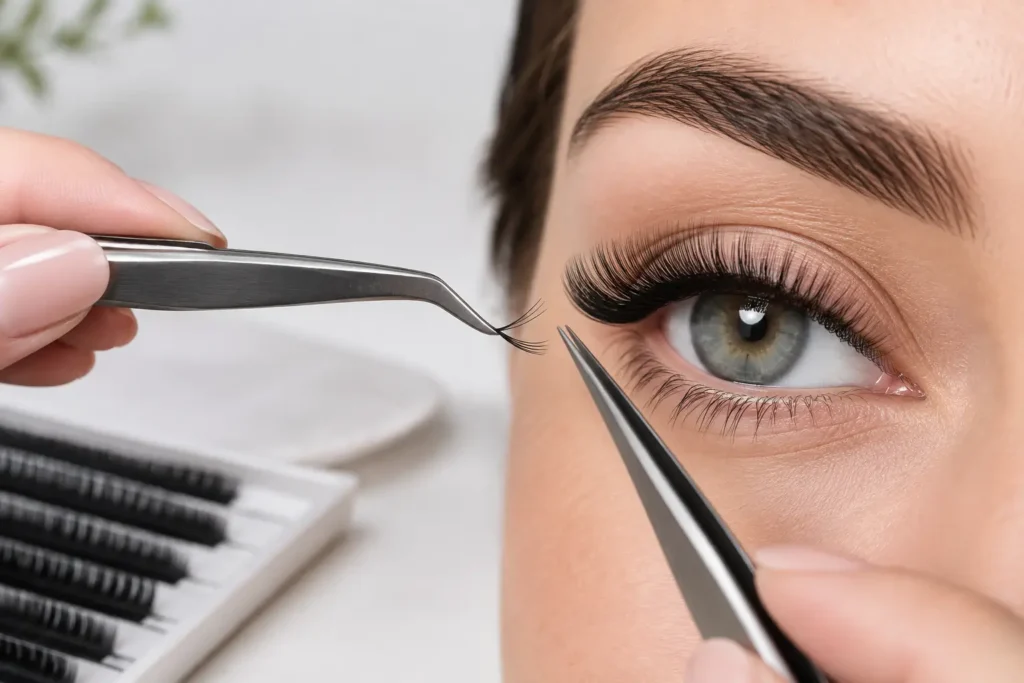


A single lash placed with an inaccurate grip can change the entire line of the eye. In classic technique, this often means lost seconds and extra correction. With volume fans, the wrong tool can open the fan before it even reaches the natural lash. That is why professional tweezers are not chosen by looks alone, but by technique, hand strength and the way you work every day.
For a lash artist, tweezers are a core working tool, not a secondary accessory. They affect isolation speed, fan stability, the amount of adhesive and comfort during long procedures. A well-chosen model will not do the technique for you, but it lets your skills show in the result.
What role do professional tweezers play
Eyelash extensions usually require at least two tweezers: one for isolation and one for placing the extension or shaping a volume fan. This split is not an unnecessary expense. Isolation requires a stable, fine and predictable tool, while for placement the contact area of the tip, the angle and a comfortable grip matter most.
Quality tweezers should close evenly, without the tips misaligning. If a gap remains between them, even under pressure, you will drop fine lashes and squeeze harder than necessary. This slows down the procedure and strains the wrist, especially when you see several clients a day.
Not every pair of professional tweezers is universal. A model that is excellent for classic placement may not give you control with 4D or 6D volumes. The choice also depends on your habits: some specialists work confidently with a firmer grip, while others prefer a soft close and less tension in the fingers.
Tweezer shapes and what they are for
Straight tweezers for isolation
Straight tweezers are the standard choice for separating natural lashes. They give good visibility of the base and let you work cleanly without touching neighboring lashes. They suit both beginners and experienced lash artists, because the movement is easy to control.
For clients with dense or strongly curled natural lashes, you may prefer slightly curved isolation tweezers. They provide easier access in certain areas but require a short adjustment period. What matters is that the tip is fine enough without being aggressively sharp when working near the eyelid.
Curved tweezers for classic placement
Curved models are a practical choice for classic technique and light hybrid sets. The curve helps you pick a single lash from the strip, dip it in the adhesive and position it at the right angle to the natural lash.
Here, the contact between the tips is decisive. If the tool grips firmly only at one small point, you will have to find the exact spot with every pick-up. This may be acceptable for single lashes, but it is not efficient in more intensive work. Tweezers with an even grip along a larger part of the tip usually give more ease and control.
L, boot and volume tweezers
Tweezers with an L-shaped, boot or wider curved tip are designed for volume techniques. The larger contact area makes it easier to pick up several fine lashes at once and helps the fan stay open until placement.
When making fans by hand, the choice depends heavily on your method. If you fan the lashes on the strip, a wider grip area can give you good support. If you shape the fan between the tips, you may prefer a more precise, slightly curved model. There is no single right shape for everyone. The most useful tweezers are the ones that let you keep the same result from the first client to the last.
How to check the grip before work
Before adding new tweezers to your working set, do a quick test with lashes in the thicknesses you use most often. Pick up a single lash, then 2-3 fine lashes, and finally try to form a small fan. Check whether the tips close at the same time and whether the lashes slip with a slight movement of the hand.
Look for the so-called working zone of the grip. On some models it is close to the very tip, on others it starts a little further back. Once you find it, you will work faster and with less pressure. If you constantly have to squeeze hard, the tool is probably not right for your technique, or that specific model does not suit your hand.
Do not judge tweezers by the first five minutes alone. Do a real practice session on at least one lash strip. Weight, balance and closing effort are felt most clearly after a series of repeated movements.
Material, finish and ergonomics
Professional пинсети за миглопластика най-често са изработени от неръждаема стомана. Тя е практична за професионална среда, защото позволява регулярно почистване и дезинфекция според инструкциите за конкретния инструмент и използвания препарат. Винаги проверявайте съвместимостта на покритието с методите за обработка във вашия салон.
The finish can be matte, colored or with a smoother surface. It is not just a matter of looks. A matte finish often reduces glare from the lamp, which helps with precise work. Colored tools make organizing your workstation easier when you want to tell the isolation tweezers apart from the volume ones.
Ergonomics has a direct cost for your business. Thumb pain, wrist strain and finger fatigue reduce consistency in your work. If you do many procedures a week, do not choose just the lightest or the prettiest model. Compare the length, the body thickness and the force needed to close them. Sometimes slightly heavier but well-balanced tweezers are more comfortable than overly light ones that require strong pressure.
Care that preserves the tool's precision
The tip is the most vulnerable part of the tweezers. A fall onto a hard surface can bend the grip even when the damage is not immediately visible. Store your tools in a case, a stand or a protective container, not loose in a drawer with other metal accessories.
After each procedure, carefully remove adhesive residue with a suitable product and without harsh scraping. Dried adhesive on the tips changes the contact and makes precise work impossible. After cleaning and disinfection, dry them thoroughly so that no traces of moisture or product remain.
It is good practice to have a spare set. This is especially important for salons with a busy schedule, for trainers and for academies where several trainees work at the same time. Spare tweezers prevent interruptions if the main tool falls, gets contaminated or needs additional cleaning.
How to build a working kit for your services
For classic eyelash extensions, start with straight tweezers for isolation and curved tweezers for placement. This is a functional base that covers daily work without piling up unnecessary tools. If you offer hybrid sets, add a model with a more secure grip for several fine lashes.
For volume techniques, it makes sense to test at least two different types of tweezers. One can be L-shaped or boot-shaped for a wider contact area, and the other – fine curved tweezers for smaller fans and detailed work in the inner corners. That way you will not have to change your whole technique to fit one tool.
For training groups, it helps to structure the kits the same way. Trainees learn isolation, grip and positioning more easily when they work with predictable tools. VM Beauty maintains a professional catalog that makes regular supply easier for salons, independent specialists and academies.
Tweezers should not make you compensate with more pressure, more time or more corrections. Choose a shape that fits your technique, test the grip with the actual lashes you use and maintain the tool as part of your working standard. When your hand works calmly, precision shows in every clean isolation and every securely placed lash.



