


The first few procedures in training show whether an eyelash extension course and its supplies have been chosen professionally. Quality supplies don't replace the instructor's technique, but they give students a real chance to practice proper isolation, control of the adhesive, building fans and clean placement. When a kit contains randomly chosen products, time is spent compensating for problems that have nothing to do with the future lash artist's skills.
For an academy, supplies are part of the training standard. For students, they're the first work kit they'll use to build habits and a portfolio. That's why the selection should follow the course program, the group's level, and the techniques that will actually be taught, not just the lowest price per item.
What supplies you need for an eyelash extension course
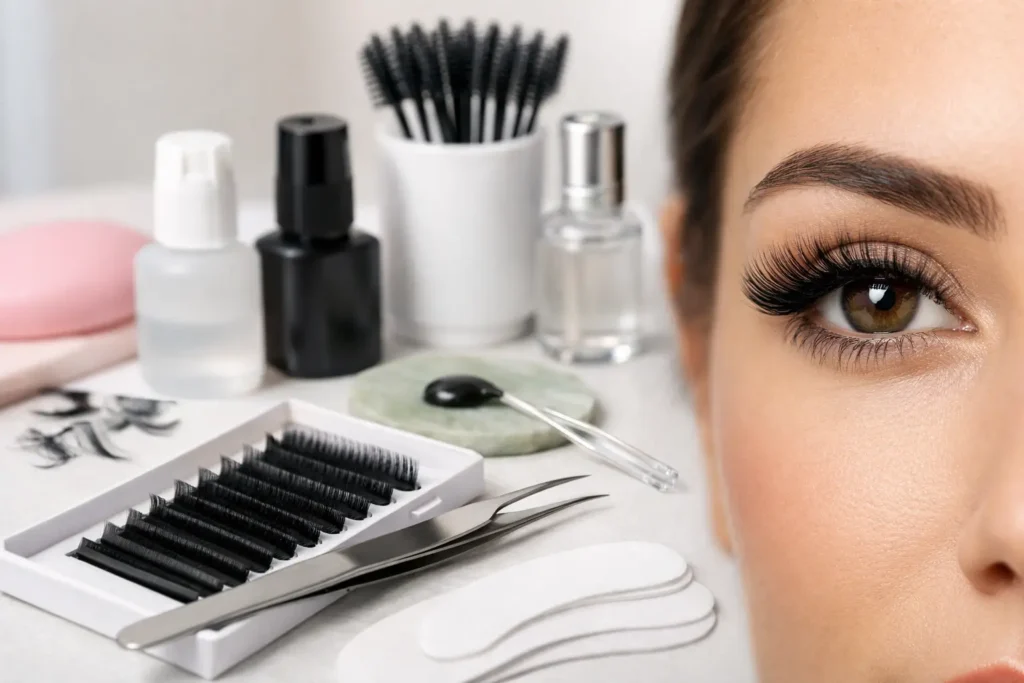
A basic kit for the classic technique should allow a full procedure on a practice mannequin head and work on a model under supervision. You need lash trays, adhesive, primer, remover, eye patches, micro brushes, spoolies, tape, tweezers, and suitable hygiene supplies. A well-organized kit also includes a lash holder, a jade stone or another surface for the adhesive drop, and a fan or blower to finish the procedure.
It doesn't make sense for all products to come in a single format. In practice, students need to understand why eye patches are chosen according to eye shape, why different tapes have different holding strength, and why tweezers that are comfortable for classic placement don't always work well for volume fans. This doesn't mean overloading the starter pack with unnecessary items. It means having enough variety for explanation and supervised practice.
Lash trays: what students should start with
For classic eyelash extension training, the most practical option is a tray with lengths in the 7-13 mm range. This lets the instructor demonstrate proper mapping, smooth transitions, and safely matching the natural lashes. A thickness of 0.15 mm is a good start for classic placement when the model's natural lashes allow it. A 0.10 mm tray also has a place in the kit, especially for finer natural lashes and a lighter finish.
For volume techniques, students should work with lighter thicknesses, most often 0.07 mm and 0.05 mm. A stable strip, even fiber distribution, and easy release matter because beginners are still developing their tweezer movement. Lashes that are too stiff or a poor-quality strip cause fans to fall apart and lead to unnecessary frustration. The most commonly used curl for training is C, while CC and D can be added for comparison and for working with different eye shapes.
Adhesive is a working parameter, not a universal product
Adhesive is the item that depends most on the training room environment. Temperature, humidity, ventilation, and working speed all affect how it behaves. An adhesive with a very fast drying time isn't automatically better for beginners. If a student can't isolate, dip, and place the lash at the needed pace, they won't be able to tell whether the problem is their technique or a prematurely cured drop.
For basic training, a medium-speed adhesive that gives time to correct the position is often more suitable. More experienced groups and volume trainings can use faster formulas, but only after the instructor has checked the conditions in the room. Always follow the optimal humidity and temperature guidelines for the specific product.
The kit should also include primer for prep, remover for controlled removal of extensions, and supplies for safe application. They are used according to their purpose and the manufacturer's instructions. A course is no place to improvise with the amount of adhesive, placing products near the waterline, or mixing different liquids without a clear reason.
Tweezers and small supplies that set the pace
One straight or slightly curved isolation tweezer and one L-shaped or curved placement tweezer are the practical basis for a classic course. For the volume technique, tweezers with a grip better suited to forming fans may also be needed. The best model isn't necessarily the one with the most aggressive price or the flashiest design. What matters is a precise tip, a secure grip, and balance in the hand.
Micro brushes, spoolies, and applicators seem like a small expense, but in a course setting they're used up quickly. Plan enough for each student and don't count on one supply being passed between workstations. Eye patches, tape, disinfectants, disposable sheets, masks, and gloves should be budgeted per model, not just per participant.
How to structure kits by level
A single kit for all trainings is rarely cost-effective. Beginners need clearly organized basic supplies and enough quantity for repetition. A student learning classic one-to-one doesn't need a full range of ultra-fine lashes, premade fans, and several types of specialized tweezers on day one. That raises the initial investment without improving how well they learn the basics.
For volume training, the kit should build on the basic one, not duplicate it aimlessly. Add 0.07 mm or 0.05 mm trays, suitable tweezers, more strips for practice, and an adhesive matched to the faster working pace. Advanced modules can include lashes in different curls, brown shades, statement lengths, or products for creating a wet-look effect. The choice depends on the program and on which services students will offer after the training.
It's useful for academies to prepare two types of stock. The first is an individual starter packthat the student keeps. The second is a shared supply for the training room: extra eye patches, adhesive, micro brushes, tape, and spare trays. That way, running out of one item won't interrupt the practical part.
Kit price and cost control
The cheapest kit may only look like a good deal before the course starts. If the lashes are hard to release, the adhesive doesn't work in the room's conditions, or the tweezers don't close precisely, the loss comes in the form of delayed exercises, wasted supplies, and less confident students. A smarter approach is to choose reliable professional products in the right quantity rather than many items of unproven quality.
Plan the cost per person based on the number of practice models and the techniques in the program. Include a reserve for spilled adhesive, replacing eye patches, extra practice, and unexpected situations. For regular groups, it's more efficient to stick with the same brands and formats. That way the instructor knows how the products behave, and students can easily order the same supplies after finishing the training.
VM Beauty works with professional brands and offers terms for trainers and academies, which makes it easier to plan regular groups and maintain a consistent standard across kits. When choosing products, look for accurate specifications, clear formats, and stock you can count on for the next training as well.
Common oversights when preparing training supplies
The first oversight is buying just one of each product for demonstration, with no reserve for real practice. The second is choosing an adhesive based on its advertised speed rather than the students' level and the room's conditions. The third is cutting back on hygiene supplies, even though they're directly tied to safely organizing the procedure.
It's just as problematic when a student receives a kit with no explanation of what it contains. A short list with the product name, its function, how to store it, and when to use it turns the supplies into a working system. It reduces mistakes after the course and helps beginners restock sensibly instead of buying at random.
Well-chosen supplies won't turn a lash artist into a finished specialist in two days, but they let them learn on a predictable foundation. That's the best start for students and the surest way for an academy to protect the quality of its training.



