
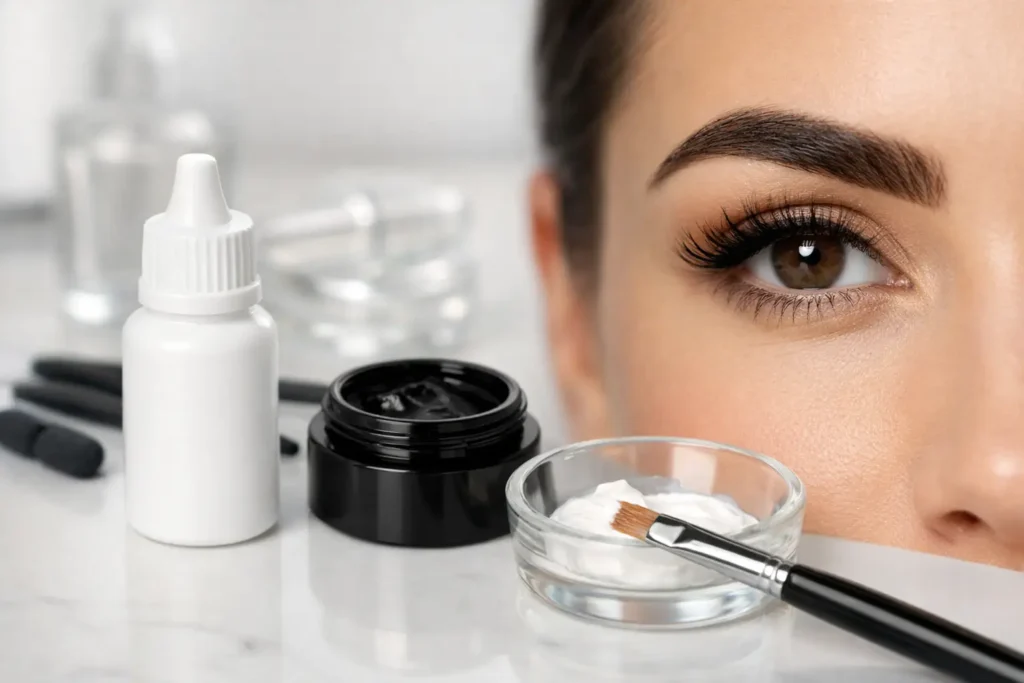


The same brow tint can give a soft, even result on one client and an overly dark or uneven stain on another. Often the reason isn't the shade but the activator. The question of which developer for brow tint to use isn't decided by percentage alone: the formula of the specific brand, the technique, the condition of the hair, and the desired finish on the skin and brows all matter.
For a brow artist, developer isn't a universal supply that simply “activates” the tint. It plays a part in color development and affects the consistency of the mixture, working time, and how predictable the result is. The right combination means fewer corrections, cleaner outlines, and more consistent quality with every procedure.
What role does developer play in brow tinting
Developer, also called activator, contains hydrogen peroxide at a specific concentration. When mixed with the tint, it starts the oxidation process through which the color precursors develop into visible pigment. This allows the color to set on the hair and, depending on the formula and technique, to leave a stain on the skin as well.
The percentage doesn't indicate how much “better” the tint will take. A higher concentration isn't automatically the answer for a longer-lasting or more saturated result. In the brow area, the goal is controlled shade development with maximum comfort for the skin and gentle treatment of the hair.
There's one more key detail: developer is part of a system. Tint and activator are designed to work together, with a specific ratio and processing time. Mixing tint from one brand with developer from another can change the pH, the consistency, and the final tone. Sometimes the result looks acceptable, but it becomes harder to predict at future procedures.
Which developer for brow tint based on the formula
Cream activator 1,8%
Low-percentage cream activators are the most common professional choice for classic brow tinting. They usually mix easily with cream tint, don't run, and allow precise application with a brush. This is especially useful for brow architecture with a clean lower line, working on individual hairs, or when you want even color without an aggressive effect on the skin.
The low concentration supports controlled shade development. With the right tint, it's suitable for most standard procedures, including thinner, dry, or previously treated brows. However, don't expect a 1,8% activator alone to create a graphic skin stain. The stain on the skin is largely determined by the type of tint, degreasing, prep, application method, and processing time.
Developer 3%
3% developer is also widely used with lash and brow tints, but it isn't interchangeable with every 1,8% cream activator. It's chosen when the specific product system requires it. For some brands, 3% is the standard developer, and it's what the manufacturer used to test the palette, processing time, and shade predictability.
Here, professional discipline is worth more than experimenting. If the tint instructions specify 3%, use 3% in the specified ratio. If the system was developed for a 1,8% cream activator, don't swap it for 3% hoping for a stronger tint. The risk is that the tone develops differently, the mixture becomes too runny, or the result is uneven on porous skin.
Activator for hybrid tint
Hybrid tint works differently from classic cream tint. It's designed to color the hair and leave a more visible stain on the skin, which makes it a favorite for shaping more defined brows. However, this formula has its own activator and its own working technology.
With hybrid systems, follow the brand's recommendations for ratio, consistency, and time exactly. Some formulas require a runnier mixture, others work with a creamy texture. If you add too much activator, the tint can become watery, bleed outside the outline, and give a weaker or patchy skin stain. Too little activator isn't the answer either: the mixture develops unevenly and is hard to apply precisely.
Don't choose by percentage alone
When a specialist asks whether to work with 1,8% or 3%, the most useful answer is: first check what the tint requires. The percentage is a technical parameter, but it can't replace the manufacturer's protocol. A professional kit should contain tint and a compatible activator from the same line, especially when you work with hybrid formulas and are building a recognizable signature style in the salon.
Consistency matters too. Cream activator gives a thicker mixture and is often more convenient for precise brow architecture. A liquid developer may be the right choice for a system that requires a lighter texture, but when freely combined with an unsuitable tint it makes control harder. When working with a thin angled brush, any bleeding means extra cleanup and the risk of an asymmetrical outline.
Shelf life after opening also deserves attention. Hydrogen peroxide loses activity on contact with air, light, and high temperatures. An activator that has been open for a long time or stored next to a heater can give a weak and unpredictable result. Close the package right after use and keep your stock with sensible rotation of supplies.
Tint-to-developer ratio: why precision pays off
In brow tinting, eyeballing it is an expensive habit. A small difference in ratio can change the consistency, shade development, and product usage. A 1:1 ratio is common for standard cream tint, but it isn't a rule for all brands. With hybrid tints and individual lines, the ratio may be different.
Work with a non-metal palette and spatula. Metal can affect the reaction with some formulas, and it also makes it harder to maintain a good hygiene protocol. Squeeze out the amount of tint you need, add the activator according to the instructions, and mix until completely smooth. There should be no streaks, dry particles, or air bubbles.
In trainings and team work, it's good practice for every specialist to use the same measure, for example a set number of drops, a marking on the palette, or a precise spatula. That way you can easily track why a shade worked perfectly and repeat the result at the client's next visit.
Prep matters more than activator strength
The best developer won't make up for makeup, sebum, SPF, or cosmetic residue on the area. Before the procedure, cleanse the brows with a suitable product, degrease carefully, and assess the condition of the skin. On exfoliated, irritated, or very dry skin, the stain may develop unevenly regardless of the activator percentage.
Also take the client's history into account. Brows after lamination, bleaching, a chemical peel, or active home care with retinoids call for a more careful approach. Don't work on injured or inflamed skin. Always do a sensitivity test according to the manufacturer's instructions and the salon's internal protocol. If you're also doing brow laminationat the same visit, plan the order of procedures according to the manufacturers' instructions.
Don't extend the processing time arbitrarily to make it “take more.” Leaving it on longer can give you an overly dark tone, an unnatural coolness, or an uneven stain. It's better to adjust your next shade choice, layering technique, or prep than to change the basic parameters without control.
A practical choice for your professional kit
For consistent work, keep activators organized by brand and system, with the opening date clearly marked. Don't decant products into unlabeled bottles, and don't use one developer for all the tints in your cabinet. This saves time during the procedure and reduces mistakes when setting up your working palette.
If you're just building your brow menu, start with one reliable system for classic tinting and one for a hybrid effect, instead of collecting incompatible products. VM Beauty offers a professional selection of tints and their matching activators, making it easier for salons to restock with a clear logic rather than compromise combinations.
The best developer is the one that's compatible with your chosen tint, used in the exact ratio, and gives you repeatable results. When every procedure starts with the right system, the client sees clean color, and you gain the most valuable resource in the salon: the confidence that you can deliver the same quality again.



