
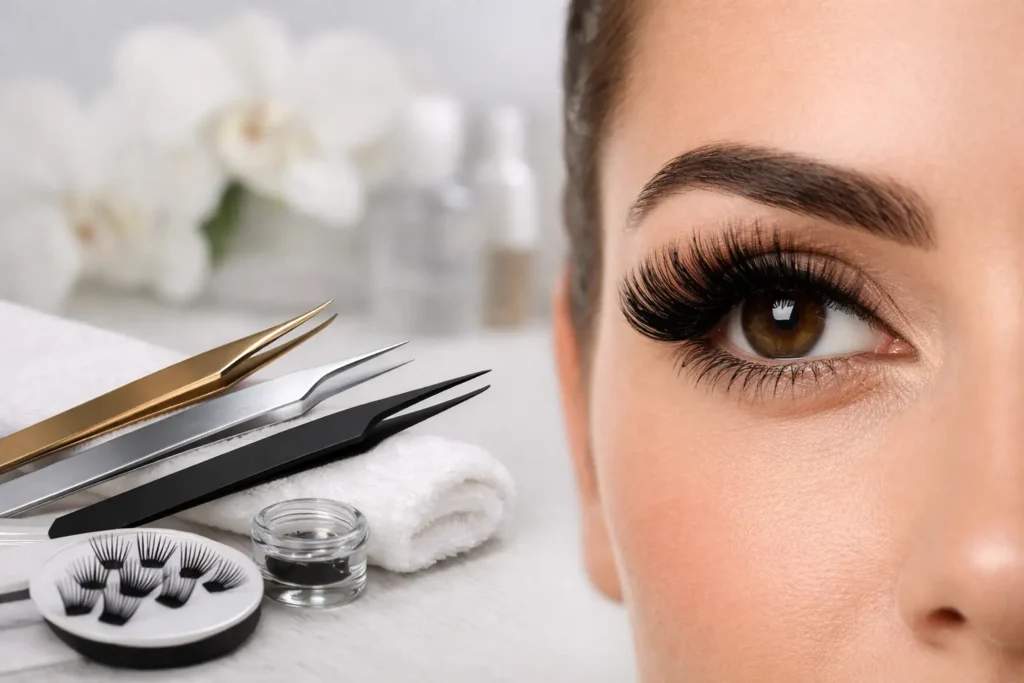


In volume eyelash extensions, tweezers for volume lashes aren't just a tool from the starter kit. They determine how securely you hold fine lashes, how quickly you form a fan, and whether it stays even until you place it on the natural lash. Even high-quality lashes and the right adhesive can't make up for tweezers with an imprecise grip or awkward geometry.
For a professional, the right choice isn't about which shape looks good in a photo. What matters is your working technique, the lash thickness, your hand position, and how you create the fan: from the strip, in hand, or by transfer. Good tweezers reduce unnecessary movements and keep the procedure on pace without compromising clean work.
What sets tweezers for volume lashes apart
Tweezers for classic placement are designed mainly to pick up and position a single lash. In volume techniques, the tool has to hold several extremely fine fibers at once without them shifting, bending, or the fan closing. That's why the working end is usually curved, with a wider contact area between the tips.
The most valuable feature is an even grip along the length of the tip. If the tweezers hold the fan at only one point, you'll often have to squeeze harder. This strains your hand, slows you down, and increases the risk of crushing the base of the fan. With a quality model, the lashes stay secure with moderate pressure, and the tips close precisely.
How the tweezers “release” the lashes also matters. When placing the finished fan on the natural lash, you shouldn't need a sharp movement or extra opening of the tip. The more controlled the release, the easier it is to keep the direction, base, and symmetry of the volume.
Choose the shape based on your technique
There's no single universal shape for all lash artists. A model that works perfectly for a strip-forming technique may be awkward for a specialist who makes fans in hand. Instead of following a popular shape, notice exactly where you lose control during the procedure.
L-shaped tweezers
L-shaped tweezers have a distinct angle and a wide gripping area. They're a preferred choice for 3D, 4D, and larger volumes, especially when you work with fine 0.05 mm or 0.07 mm lashes. The shape makes it easy to separate several fibers from the strip and hold them while you form the fan.
This type is practical for working from the strip, but you need to find the right grip point. If you grip too close to the base, the fan may stay closed. If you work too high along the length of the lashes, there's a risk the fibers will slip while you move them to the adhesive.
Boot tweezers
Boot tweezers have a wider, rounded working tip. They provide a large contact area and stability with wide, soft fans. Many specialists choose them for Russian volume and for techniques where the fan is formed by gently sliding along the strip.
The trade-off is that the wider tip can feel bulkier when working in the inner and outer corners. If you often create detailed maps with short lengths or work close to the eyelid, test whether the shape gives you enough visibility and freedom.
Curved tweezers
Curved models are a good option for lash artists looking for a lighter tool and a natural wrist position. The moderate curve gives control with small to medium volume and is convenient for mixed techniques when you combine classic, hybrid, and volume zones in one procedure.
With very large fans, the contact area may not be enough for every working style. This isn't a flaw of the tweezers themselves but a matter of compatibility with your technique and the volume you offer in the salon.
Grip matters more than looks
Two tweezers that look identical can behave completely differently in the hand. The reason is the tip alignment, closing force, and balance of the tool. Before adding a new model to your work routine, do a short test with the lashes you use most often.
Pick up a few fibers from the strip and check whether the tweezers hold them securely at different points along the tip. Form a few fans with your usual technique, dip the base in adhesive, and release them onto a practice surface. If the fan closes during transfer, the cause may be too much pressure from your hand, but it could also be an uneven grip from the tool.
Consider the stiffness too. Softer tweezers close with little effort and are often comfortable during long procedures. However, they may not give the stability you need with very wide fans. A stiffer model provides firm control, but with an incorrect hand position it strains your thumb and index finger. The best choice is the one you can work precisely with at the end of a busy day, not just for the first ten minutes.
Match the tweezers to thickness and volume
The finer the lashes, the more precise the grip needs to be. With 0.10 mm and 0.07 mm lashes for lighter hybrid or 2D-3D volume, many specialists work comfortably with curved tweezers or a narrower L-shaped tip. With 0.05 mm, 0.04 mm, and 0.03 mm lashes for larger volumes, the wide contact area of boot or L-shaped tweezers usually gives more security.
Don't choose a tool based only on the number of D. Lash length, material, strip stickiness, and pick-up technique all change the feel. A 6D fan of 0.05 mm can behave differently from a 6D fan of 0.07 mm, even with the same shape and curl. That's why it makes sense to have at least two proven volume models in your work kit, rather than one pair of tweezers for every possible technique.
Common reasons fans fall apart
When a volume fan closes, the first reaction is often to switch the adhesive or lash brand. Check your workflow first. The tweezers may have gripped the fibers too high, may not close evenly, or the tip may have adhesive residue on it.
Another common problem is squeezing too hard. With fine lashes, strong pressure deforms the base and changes the arrangement of the fan. Work with the minimum force needed for a secure grip. If that's not possible, change the grip point or the model instead of compensating with more pressure.
Pay attention to ergonomics too. If your wrist bends unnaturally and your shoulder lifts when working on the outer corners, the shape of the tweezers probably doesn't fit your position. A technically right tool should support your posture, not force it.
Maintenance that keeps them precise
Tweezer tips are delicate. Even a light knock against a metal stand, a drop on the floor, or improper cleaning can throw off their alignment. If your tweezers fall, don't put them straight back into the procedure. Check the grip with a few lashes and set them aside if the tips are misaligned, so you don't waste time and material in front of the client.
Clean off adhesive residue promptly with a product suitable for professional tools, and follow the manufacturer's disinfection instructions. Don't scrub the tip aggressively or leave the tool in an unsuitable solution for a long time. After treatment, dry it well and store it in a case or stand where the tips don't touch other tools.
For salons with a busy schedule, it's practical to keep several working tweezers of the same or a similar shape. That way you have a backup if one falls, needs cleaning, or has to be swapped during a procedure. When regularly restocking supplies from VM Beauty, choose models that match the services you actually offer, not a passing trend in techniques.
Good tweezers won't create the volume for you, but they make every movement more predictable. When the grip, shape, and stiffness suit your hand, you can put your attention where the client sees it: in a clean base, the right direction, and a lasting, beautiful result.



